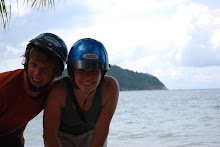
Thursday, December 18, 2008

Dolphin Day!

We've got some seriously slow internet here in the town of Kratie...so today will be another day without pictures. We realize that it's not the same but frankly you've been a little spoiled. You may not get any for a week or so, since we'll be going deeper into the remote North of Cambodia.


Today we rented another couple of clunkers, and biked15km north of town to see the remaining Irrawady Dolphins in the Mekong River. The Mekong is quite the river. Perhaps you've heard of it. It's the largest river in south east Asia, and stretches on for nearly 5000km. It's second only to Amazon as the most biologically diverse fresh water ecosystem on the planet, and it dumps the 3rd largest amount of fresh river water into the oceans in the world. Right now it's the dry season but it still is by far the largest river we've ever seen. It's waters are very muddy, and the current is really strong, so we didn't get to swim with the dolphins.

The bike ride was really pleasant as far as scenery goes, but very uncomfortable for our butts. the bikes really were lousy. Oh well. The dolphin viewing was good. Fresh water dolphins are very shy, so it's not as though they were bumping into the boat and letting us pet them, but we did get some good views of them surfacing close by. It was a nice way to spend the morning.

The afternoon was a lazy one. We both had a nap and read our books. Tomorrow we're off to Ban Lang.

Wednesday, December 17, 2008

We ate spiders!

We are writing you from Kratie (pronounced Kra-chuh), a beautiful little city on the edge of the Mekong River. We took a bus today from Phnom Penh and had a fairly uneventful 6 hour trip here. I would almost say it was completely uneventful, but, today was the day we ate Torrantula. After being on the bus for only a couple hours we stopped for breakfast at a Cambodian style service centre/rest stop. Of course there was the usual fruit and rice options to purchase, but along with that were platters of spiders. It was pretty intense. I'm sure most Cambodians would laugh to read this and think it funny that we find eating spiders odd. They eat anything, really anything, here! So, we were brave and each ate a leg! I wish I could say that I ate the whole thing, including the gushy stomach, but I wasn't that brave.

So, the next question is, how did it taste? They cook or marinate them in some kind of soy sauce concoction (we're guessing). It was crunchy and hairy and actually didn't taste that bad. It's one more thing checked off our list of things to do. I wouldn't say we'll be making spider a part of our daily diet.

We don't have to much else to report. We checked into a really nice guesthouse and enjoyed a beautiful sunset over the river. Tomorrow we're planning to rent some bicycles and take a little boat ride on the river to hopefully see some of the only remaining fresh water dolphins in the Mekong.

...sorry we've been trying to put pictures on here but it's not working out. There will be proof of spider consumption.

Monday, December 15, 2008

What's to be Done?


Yesterday was a sobering time for us, as we visted a couple of the history sites surrounding Cambodia's blooody past.
First we went to a Musuem which was called S-21. During the time of Pol Pot's reign of terror, the Khmer Rouge converted Phnom Penh's biggest highschool into a prison. All of the classrooms were converted to prison cells. Here the Khmer Rouge brought prisoners which they thought would contaminate their intended classless society. If you were educated, biligual, literate, or even had children with similar qualities you were an immediate target. This prison was not where all, or even most of the killings took place during the Khmer Rouge's reign, which began in '75, but it was the largest one in the city, and it's estimated that more than 10,000 prisoner were excuted after behind held there. The Khmer Rouge only really kept track of adult killings, so it's only a guess has to how many children were also killed.


The prison, now turned into a genocide museum, was a very hard place to be. There are many photo's of the people who died, as well as photos of the terror that took place when the prison was functioning as such. It was very informative though. The history that we learned while being there helped us to clearly understand the events that led up to the genocide, as well as the events that led to the liberation of Cambodia by Vietnam. We learned a lot.
After we went to an area outside the city which has been called "The Killing Fields". This was the area where most of the prisoners from S-21 were taken to be killed. It's basically a field filled with hundreds of shallow graves, in which the Khmer Rouge pilled the dead into after they forced them to dig the grave themselves. All of the graves have been excavated so that the bodies could be creamated in the buddist way. All over the area there are empty pits. There's bones that are still embeded in the dirt, and even clothes are stuck in the ground or pilled up against trees. There wasn't much to say while walking through the field. We just walked around in silence and thought of the horror that must have taken place there.

So naturally after the genocide in Cambodia which left more than 1/4 of it's population dead, the world learned it's lesson...right? Unfortunatly not. Several other genocides have happened since, and continue to happen now. Do we even know what's really going on in Sudan, or Somalia, or the DRC? How can the world just sit by and let events like this take place? What can be done?
Perhaps when the super power countries of this world value human lives more than money or oil, somebody might do something to stop the genocides before it's far to late. Until then though, most of us will only learn of the millions of lives lost when the countries that are at civil war are at peace again, and a museum opens when it's safe to visit.
I realize its not as simple as that, but that seems like the obvious place to point the finger. It's also stagering to realize what human beings do to each other. How can people be so evil? Will there always be so much hate? The questions go on and on.

But I think the rubber has to meet the road again. What am I going to do? What are you going to do? Sure, I can just sit at home and watch the news, and perhaps even shed a tear for the millions who perish or become refugees. But when I'm old in my warm bed, will those tears have made a difference? Or should I just write a cheque? Will that have helped? I really don't know? What now? ......?

Sunday, December 14, 2008

Phnom Penh


We'll we're here in the capital, with not to much to report as of yet. We're here after a 6 hr bus ride, and we're staying at a place with a cool view over the lake in the city...pictured above. We liked the floating houses so much that we thought we stay in one ourselves. Although the problem at this one is that most of the guest are floating on ganja. So we think we'll switch places tomorrow. That's it for now.

Saturday, December 13, 2008

The Motorbike Bandits


After a few days in bed, I am very happy to say that I'm back on my feet and have an appetite again. As Brian hoped, Monty has taken a hike. We're really hoping we don't run into him again on this trip!

Today was a great way to celebrate my return to health! Brian and I took a motorbike tour into the countryside around Battambang. We had a great tour guide and some great company with a couple of Kiwis we met at our hotel.

This is a "cricket catcher". At night they put a battery powered light above the white plastic and the crickets fly into it. They then fall into the pan beneath it and are trapped in the water. Khmers collect the crickets and they become part of their meal for the day!

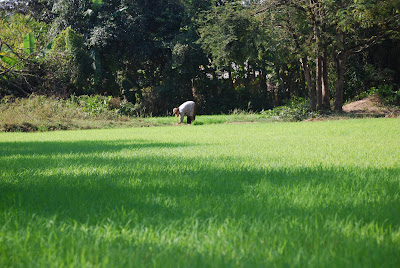
The scenery on our trip was amazing. This whole area of Cambodia is very flat (as I think most of the country is). Everywhere you go, people are growing rice. Rice grows during the rainy season and can take up to 6 months to mature. They are able to grow another type of rice which is called "summer rice", and as the name suggests it is grown in the summer. It only takes 3 months to harvest this type of rice.

A woman thinning summer rice. I think this would be worse than suckering grapes!


A view of the flat rice fields stretching as far as the eye can see!


The first stop on our trip was to the "Killing Caves". I'm sure many of you have heard about the horrible massacre of the Cambodian people under the Khmer Rouge. We'd heard about it, but only since we've been here have we learned the details of the horror that these people have gone through. I'll give you a bit of history now, but perhaps we can follow it with some more background later on. The Khmer Rouge gained control of Cambodia after many years of war. Initially everyone was excited as they promised freedom for the country of Cambodia. It took only days for people's joy to turn into fear. The Khmer Rouge commanded everyone living in cities to leave the city and head into the country. They told the people only to pack what they would need for three days. They then marched all the people from the cities into the countryside where they forced them to live, never to return to the country again. Then began the reign of killing. They believed that anyone educated, or anyone that lived in the city was too "Americanized" and that they should be killed. Anyone who was heard grumbling or complaining about the new leaders was immediatly "taken to school", in otherwords, killed without warning. Whole families and villages were massacred with sticks or hoes and then often thrown into caves or graves to die. At the caves we saw today it is believed that over 10 000 people were killed. It was a very sobering place to be.

People were thrown down into the caves through this opening. The fall was about 10 metres.


This was also in the caves....The flags you see are Buddhist prayer flags. There is a reclining Bhudda to the left and the house in the middle had some of the bones in it from the people who were killed. The people in the photo are the Kiwis we spent the day with.

We were also able to see some fruit bats in some of the trees. These bats eat any type of ripe fruit in the area. This can be a problem for some farmers who try to fend the bats off by tying plastic bags around the trees.


A view of the river (the same one we travelled on by boat). On the right bank is a peanut farm.


The next stop on our journey took us to a local farm. We were able to see some pretty cool pigs, some pineapple plants, pomelo trees, and also got to sample some rice wine. The stuff we tried was about 30% alcohol, or so they told us, but they also offered us a pretty potent drink at 70%. We declined.

A pineapple plant!


Rice wine and bananas! (We had some great pineapple too!)

Our last stop was to see the bamboo trains people have ingeniously created to transport people and products along railway tracks. They can be assembled and disassembled within a matter of minutes if a train is approaching, and these things move! We don't have a great picture of them because they were going a little too fast for us to get a good shot.

All in all it was a great day....I don't know if you can tell or not from some of the pictures but we were absolutely filthy by the end of the day! It's soooo dusty here! We had some great showers and now it's off to the food stalls for some supper!


These next pictures are some of the cute and really friendly kids in the villages. They were always excited to see us.


Friday, December 12, 2008

He's back...

If you were with us back in the day, you might remember when we introduced you to Montezuma in Morrocco. We'll he's back, and this time Montezuma's Revenge has been directed at Erin.

That's right, Erin's got the scoots. The night we arrived in Battambang, Erin got a high fever and the bad bottom end stuff. So the last couple of days she's been in bed. The good news is, she's on the upswing.

We've been planning to do a little drive around the country side here, but her movement has stopped us from having motorbike movement.

We've met a couple of Kiwi's and are planning to venture out with them tomorrow, provided Monty takes a hike.

Wednesday, December 10, 2008

Waterworld


sunrise at the dock


Today was fantastic! We took a boat from Siem Reap to Battambang, and it proved to be one of the best journey's we've ever done!


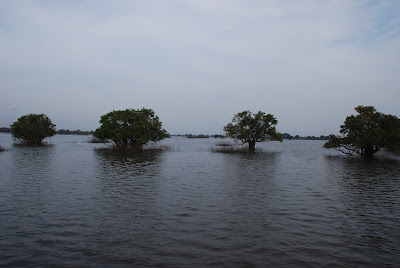
Since the roads in Cambodia are horrible, bus travel often takes a back seat to water travel if the artteries can support it. So we crossed the vast flat waterworld of Tonle Sap by boat to get to Battambang. (say bat em bong) We were told this journey was very scenic, since it passed through perhaps one of the most biologicaly diverse fresh-water deltas on the planet. The area is teaming with birds and fish. So naturally it would be pretty neat, but we had no idea that were floating into an incredible scene of human existence. preparing to squeeze past another boat


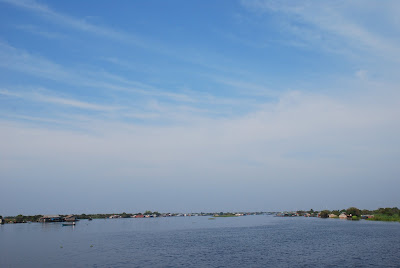
The entire area of Tonle Sap is very, very flat. The flattest thing you can imagine. Tonle Sap is a fresh water lake that is about 3000 sq. km during the dry season, and during the wet season it grows to a stagering 15000 sq. km. - not including the surrounding streams and rivers that rise by more that 4 metres. We're here somewhere in the middle of wet and dry.


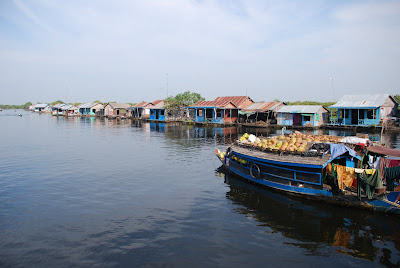
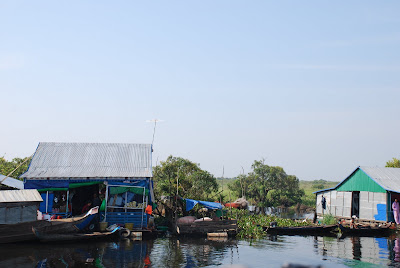
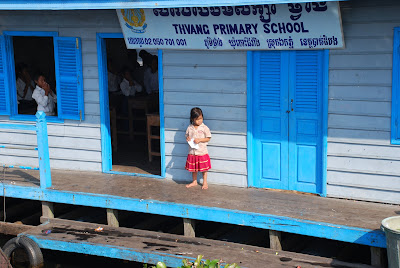
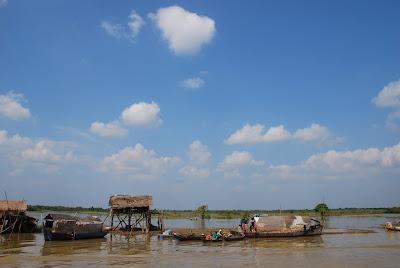
What made the trip so special, were the people who's entire life was lived not just on the banks of this massive delta, but on the water itself. As we left the boat dock we began to crossed the lake and then entered the delta, which seemed more like a maze of channels through a flooded jungle. The first villages we saw had houses that were mainly built on very tall stilts to compensate for the rising of the waters during monsoon season. As we ventured deeper into the waterworld, all forms of solid ground dissapeared. However, the people continued to live, thrive even as it appeared, in an area with no bare earth at all. Small villages lined the edges of the channels, in which all the houses were floating...and life went on as normal. They had shops for food, shops for tools and gas, even schools and temples. It was like nothing weve ever seen.


floating school


bringin' in the pinnapple
notice the outhouse? Erin loved that they even took pride in their homes.


As we went farther still, the villages became something different yet. The floating houses vanished, and mobile homes took their place. I guess you could call them houseboats... but don't picture cruising Georgeon Bay in some flash rig. These were small boats, perhaps 15-20feet long, in which a family lived and their entire life took place. Cooking, washing, and fishing all happened on board. It was really special to see they way these people lived life on the water.

see the floating pig pen? how about the tv poles? what?
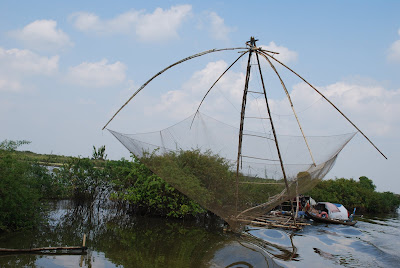


Fishing, appeared to be the only source of imcome people completely seperated from land had. Everyone we passed had nets in the water, and sometimes the going was slow as we either navageted around them, or waited for the fisherman, or fisherwomen to raise their nets. The waters were literlly over flowing with fish, and everytime we saw a net being drag aboard, it was full of little silver fish.

a big net on a hoist for raising and lowering...few at this.
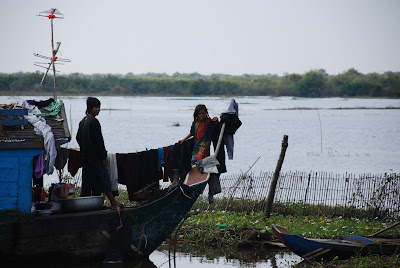


Other than simply soaking in all that was happening in this world, there were two things that made it extra cool. One highlight for me was stopping at a little floating restaurant and having an excellent meal. I don't know of many restaurants seperated from dry land by dozens of kms, where you can get a great meal of fish and fried pinnapple over rice for just under $1.


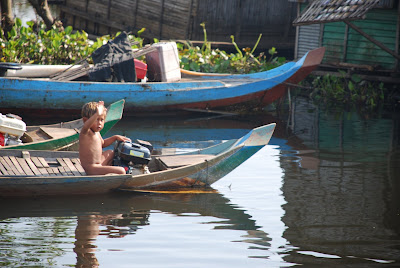
Perhaps what made these monents so moving, were the people themselves. It's really refreshing to see children and adults waving at you with all their might and shouting hello from the bottom of their heart as you passed through their world. Kids wore the biggest smiles you can imagine, and didn't stop waving until you went around the next bend. Not since Africa, have we felt like real guests on or travels. Even in this town, you're a bit of a sight for people as you walk around.


this little guy was learning the ways of the water early in life
everything happens on the boat...even tv?

This truly was a highlight of traveling here in southeast asia, and it certainly ranks very high as one of the best cultural experiences I've ever had.